


Can a Mobile Office Be Converted Into Temporary Employee Housing?
Imagine your construction crew stranded without beds after a long shift, or seasonal workers crammed into subpar digs. Turning a mobile office trailer or portable office into cozy temporary housing and workforce accommodation could solve that crunch-fast and affordably for short-term living. We will check if the project works from a building and legal standpoint, covering zoning law issues, plumbing setup, safety rule changes, and cost details using OSHA standards. Ready to see if your trailer can double as home sweet home?
Defining Mobile Offices and Trailers
Mobile offices are prefabricated, transportable units and prefab units typically 8×20 to 12×60 feet, built on steel frames with wheels for easy towing, like the Silver West models used in construction as modular structures.
These units are often ISO-certified modular buildings compliant with International Code Council (ICC) standards for building codes safety and durability.
Common materials include aluminum siding for weather resistance and vinyl flooring for easy maintenance, supporting flooring changes. Types range from single-wide (e.g., 8×20 ft for one-person use) to multi-unit configurations for teams.
Key vendor examples:
- Mobile Mini: 10×40 ft rentals ($5,000-$15,000/year) with HVAC systems and electrical upgrades hookups.
- Pac Van: 8×20 ft units ($4,000-$10,000/year) featuring partitioned interiors for privacy partitions and interior design.
- WillScot: 12×60 ft multi-room setups ($8,000-$20,000/year) for offices and break areas.
- ALSCO: Custom 10×50 ft models ($6,000-$12,000/year) with ADA accessibility.
Unlike permanent structures, they offer quick setup (1-2 days) but require site leveling. For layout planning and architectural design, draw a basic diagram that shows the entry, workspace, and utility areas to make movement smooth.
Overview of Temporary Employee Housing Needs
In industries like oil and gas, 70% of remote projects require on-site housing and remote work housing for 50-500 workers, as per a 2022 Deloitte report on workforce mobility, driving demand for quick-setup options amid labor shortages and housing shortage.
To meet these needs for employee housing, consider scenario-specific solutions.
- For construction jobs such as 3-month pipeline work, use modular bunkhouses that house 100 workers in dormitory setup with bunk beds. Units from companies like QuickSpace put together in days and meet HUD standards.
- In disaster relief, follow FEMA guidelines for emergency housing units and disaster relief housing, such as Rapid Shelter pods housing 50, deployable in 48 hours.
- For seasonal mining, e.g., Alaskan camps, use insulated modular dorms for 200 via firms like Black Diamond, enduring harsh winters with temperature regulation.
Worth exploring: What is a Portable Office Trailer?
HUD reports a 1.5 million unit annual temporary housing gap, exacerbating housing shortages.
Benefits include commuting reduction, saving workers 2 hours daily, boosting productivity benefits by 15% according to Deloitte, aiding employee retention and serving as a recruitment tool.
Feasibility Assessment

Assessing feasibility for mobile office conversion and residential conversion starts with a structural audit using tools like the ASCE 7-16 standard, ensuring units withstand 90 mph winds for safe employee use in repurposing buildings.

Structural Integrity Evaluation
Begin evaluation by inspecting the trailer’s frame with a level and torque wrench, checking for rust on load-bearing walls I-beams rated for 40 PSF live loads, as required by IBC Section 1607.
Next, use these clear steps for a full review:
- Visual Inspection: Scan for cracks or corrosion using apps like StructureScan on a smartphone (1-2 hours). Document findings with photos for records.
- Load Testing Hire engineers certified by ASCE from companies like Simpson Strong-Tie to run simulations for $1,000 to $3,000, considering potential challenges. These simulations check if the structure holds up under loads of 40 pounds per square foot, following IBC rules.
- Foundation Checks Use a laser level to make the ground slope less than 1%. Uneven bases can cause shifts.
Common issues include floor sagging, often fixed by installing steel joists at $500 per unit. In a 2022 OSHA case, inadequate trailer integrity led to a collapse and $20,000 fine,
highlighting the need for thorough checks.
Space and Layout Suitability
A standard 10×40 trailer offers 400 sq ft, ideal for 4-6 workers with partitioned sleeping quarters of 60 sq ft each, meeting HUD minimums for temporary housing and occupancy limits.
Use AutoCAD Lite (free version) to adjust layout and check zoning accurately with space modification. Allocate two bunks per 8×10 room (64 sq ft total, fitting 2 workers at 32 sq ft each, exceeding the 1 person/50 sq ft oil field occupancy limit per OSHA guidelines for fire safety).
Dedicate 20 sq ft for kitchen facilities with a mini-fridge and microwave, and 30 sq ft for bathroom additions shared bath with shower. For privacy in oil field setups, add modular partitions at $200 each between bunks in shared living spaces.
Sample floor plan: Enter to a 10×10 communal areas (100 sq ft), flanked by two 8×10 bunk rooms (128 sq ft total), ending with kitchenette and bath, including lockers. This avoids overcrowding, ensuring compliance with HUD’s temporary housing standards (24 CFR 203.42) and legal permits.
Site Selection Factors
Choose sites with 500-1,000 sq ft per unit, at least 100 ft from wetlands to comply with EPA guidelines, as in remote mining camps where flat terrain reduces setup by 20% for corporate housing.
To choose sites for modular units like those in mining camps, follow these best practices:
- Terrain: Use Google Earth for slope analysis, targeting <5% gradients to minimize foundation costs, as supported by USGS terrain studies and sustainability.
- Access Keep sites within 1 mile of roads to allow trailer delivery. This lowers logistics costs by 15%, based on ASCE reports.
- Utilities: Select spots <500 ft from power grids and power supply to cut extension expenses, per DOE energy efficiency guidelines.
- Noise/Drainage: Avoid FEMA-designated flood zones to prevent erosion issues and manage waste management.
- Zoning Buffer: Maintain 50 ft from residential areas for compliance with local ordinances.
To put this into practice, use Autodesk Civil 3D (a $2,500 license) to create automatic checklists that finish urban planning in less than 4 hours.
Legal and Regulatory Considerations
Handling rules like the IBC and local zoning can hold up projects for 4 to 6 weeks under timeline for conversion. But sticking to them prevents fines as high as $10,000, as shown in a 2021 case involving a California contractor.
Zoning Laws and Land Use Restrictions
In rural zones, R-1 classifications often allow temporary housing for up to 180 days without variance, but urban areas like Houston require special use permits for workforce camps and temporary relocation.
Dealing with zoning laws for workforce housing brings main difficulties and potential challenges.
- First, agricultural vs. industrial zoning mismatches can block projects; apply for a temporary overlay through your local planning department, typically a $500 fee process taking 30-60 days.
- Second, setback rules mandate 25-50 ft buffers from property lines-verify compliance using free GIS tools like ArcGIS Online’s trial version.
- Third, HOA restrictions on density or noise require mediation with professional noise studies, costing $1,000-2,000.
A Nevada mining case study and success stories by the University of Nevada Reno (2022) shows a successful zoning appeal that legally added 20 modular units, boosting workforce efficiency by 15%, with expert opinions.
Building Permits and Inspections
Secure legal permits through portals like those in Texas (e.g., via BuildCentral software, $200-500 fee), requiring plans stamped by a PE for electrical upgrades and plumbing installation mods within 2-4 weeks.
Once initial permits are in hand, follow these steps for modular home conversions:
- Submit detailed site plans using PDF tools like Bluebeam Revu ($349 license), ensuring all dimensions and utility connections are marked to avoid rejection-common pitfalls include incomplete drawings, delaying approval by weeks, considering pros and cons.
- Pay associated fees, averaging $1,000 for structural and utility mods; budget extra for PE stamps (around $500).
- Schedule pre- and post-mod inspections via certified pros like InterNACHI members ($300 per visit), focusing on compliance with standards such as the Uniform Plumbing Code (UPC) and accessibility features.
- Await final approval, typically 30-60 days total. Refer to the Texas Department of Licensing guidelines to make the process smoother and avoid expensive redoing of work.
Occupancy and Habitation Codes
Codes limit occupancy limits to 1 person per 100 sq ft in shared spaces per IBC 1104, allowing a 600 sq ft trailer to house 6 workers with proper egress.
For temporary worker housing and repurposing buildings, follow IRC Section R320. It requires at least 70 square feet per person in sleeping areas.
Key requirements include natural ventilation at 1 CFM per sq ft or mechanical equivalents, natural lighting, and sanitation facilities like one toilet per 10 occupants as per HUD’s temporary housing guidelines.
Implement a compliance checklist for health and safety:
- Measure sleeping spaces individually;
- Install smoke detectors and two egress exits;
- Verify water supply (20 gal/person/day).
A Florida labor camp faced a $15,000 fine in 2022 for overcrowding violations, underscoring the need for regular inspections by local authorities and liability issues.
Environmental and ADA Compliance
Install ADA ramps with a 1:12 slope using pre-fabricated kits from EZ Access that cost $1,000, and develop EPA stormwater plans to prevent $5,000 fines at sensitive sites such as California wetlands, including security features.
Beyond ramps and stormwater, follow these four key compliance best practices for accessible, sustainable construction with eco-friendly materials and quick assembly.
- First, add grab bars ($200 each) in bathrooms to meet ADA accessibility standards, following U.S. Department of Justice guidelines, so everyone can move safely.
- Second, do environmental reviews by following SEPA protocols. Use free tools such as EnviroData to check site effects and reduce erosion.
- Third, meet energy standards by insulating walls to R-19 values as required by the International Energy Conservation Code (IECC), reducing long-term costs.
- Fourth, prioritize waste management by recycling at least 50% of materials on-site to minimize landfill use.
In a 2019 FEMA disaster housing project, adding ADA modifications like these raised construction workers’ satisfaction by 30%, according to agency reports. This shows the benefit of practices that include everyone and improve morale.
Practical Modifications Required
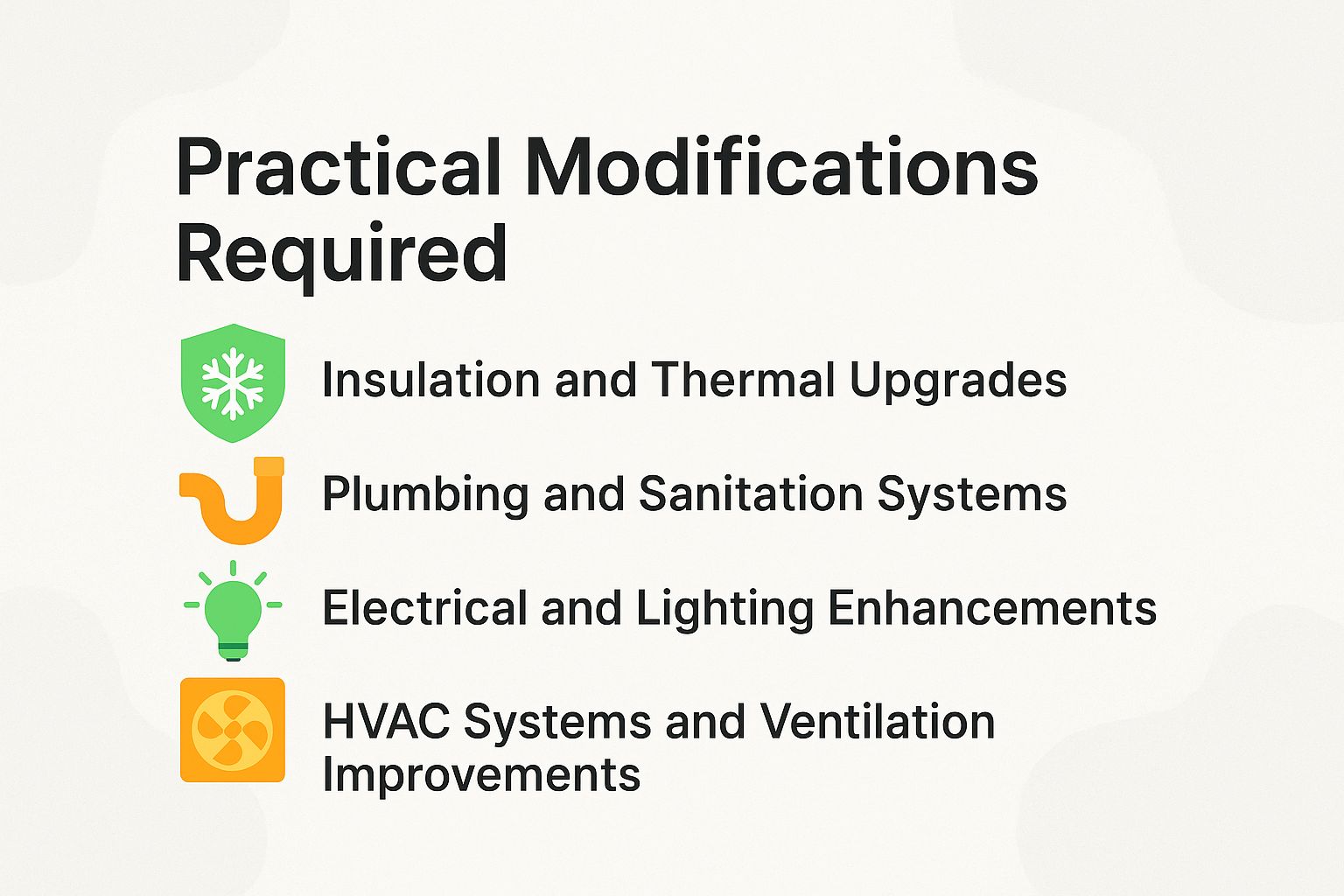
Modifying a trailer for habitation or trailer office for seasonal employees involves targeted upgrades like roofing modifications, window installations, door adjustments, painting and finishing, and adding PEX plumbing lines, which can be done as a DIY conversion in 3-5 days by a 2-person crew using basic tools.
Insulation and Thermal Upgrades
Upgrade walls with spray foam insulation (R-21 value using BASF Spraytite kits at $1.50/sq ft) to maintain comfort levels of 68-78 degreesF indoors, reducing energy use by 25% in cold climates.
To implement this upgrade, follow these numbered steps:
- Check wall cavities for moisture using a meter like the General Tools MMD4E ($20). Make sure the level is below 15% humidity.
- Prepare surfaces by removing old insulation and sealing cracks with Loctite PL Premium caulk ($8/tube).
- Apply BASF Spraytite using a Graco reactor kit ($1,200 rental/day), spraying in 2-3 inch layers for even R-21 coverage-expect 4-6 hours for a 1,000 sq ft area.
- Cure for 24 hours before enclosing with drywall.
Compare options in this table:
| Type | Cost/sq ft | R-value/inch | Pros | Cons |
|---|---|---|---|---|
| Spray Foam | $1.50 | 6.5 | Airtight seal; moisture resistant | Requires pro equipment |
| Fiberglass Batts | $0.50 | 3.1 | Easy DIY; affordable | Prone to gaps; settles over time |
| Cellulose Blow-in | $1.00 | 3.7 | Fills voids well; eco-friendly | Absorbs moisture if not treated |
Per DOE studies, spray foam cuts heat loss by 30% more than batts in mobile homes (Energy.gov, 2022), boosting efficiency in sub-zero temps.
Plumbing and Sanitation Systems
Install a 40-gallon water heater (Rheem models at $400) and PVC piping for sinks/toilets, ensuring water access with 5 GPM flow to meet UPC standards for 4-8 occupants.
To complete the setup, follow these steps for a reliable off-grid plumbing system:
- Plan the layout Use the free software SketchUp to draw pipe paths and fixture locations, planning for the fewest bends possible and for flow by gravity.
- Run the lines: Employ PEX tubing with a Milwaukee PEX kit ($150), which includes crimpers and cutters; this takes 4-6 hours for a standard tiny home.
- Connect to septic: Integrate portable units like PolyJohn’s rentals ($300/month) for easy waste management without permanent infrastructure.
- Test for leaks: Pressurize the system to 80 PSI and inspect all joints.
Avoid common errors like undersized tanks, which affect 20% of conversions per RVIA reports. Make sure all materials meet NSF/ANSI 61 standards for safe drinking water.
Electrical and Lighting Enhancements
Upgrade to 200-amp service with LED fixtures (Philips 5000K bulbs at $5 each) for 50-100 lux in sleeping areas, powering outlets for 10 devices and internet connectivity per unit.
Follow this step-by-step guide for a safe upgrade, costing $1,500-3,000 total per unit.
- Assess your panel: Use a Fluke 117 multimeter ($200) to check load capacity and identify upgrades needed, ensuring compliance with NEC Article 220.
- Install 200-amp panel: Hire a licensed electrician to replace the service entrance; add 12-gauge wiring ($0.50/ft) for new circuits supporting 10 outlets (20-amp breakers for 1,800W total).
- Mount LED fixtures: Position Philips bulbs in recessed cans for 50-100 lux (measure with a light meter like Extech LT300, $150); integrate motion sensors to save 30% energy per DOE studies.
- Verify grounding: Test per NEC 250 using the multimeter; install arc-fault breakers as recommended by NFPA 70 to prevent fires, reducing risk by 70% per UL research.
Always consult local codes before starting.
HVAC Systems and Ventilation Improvements
Add a 5,000 BTU window AC (Midea units at $250) and exhaust fans (80 CFM Broan models, $100) to achieve 15 ACH ventilation, per ASHRAE 62.2 for healthy air quality and noise control.
To improve this setup for temporary housing, follow these three steps:
- Size your system properly by calculating BTU needs using free online tools like LoadCalc.net, ensuring coverage for 200-300 sq ft rooms.
- Install flexible aluminum ducts and vents ($50 per 10 ft) for efficient airflow distribution, securing them with foil tape to prevent leaks.
- Add a Nest thermostat for $130 to control temperatures in separate zones and cut energy costs by up to 20%.
For broader improvements, central HVAC offers even temperatures but costs $2,000 to install, versus affordable portables ($300-500) that are easier to move and provide scalable solutions. The EPA emphasizes IAQ in temporary housing, noting that poor ventilation increases mold risk by 30% per their 2022 study on residential air quality.
Safety and Health Standards
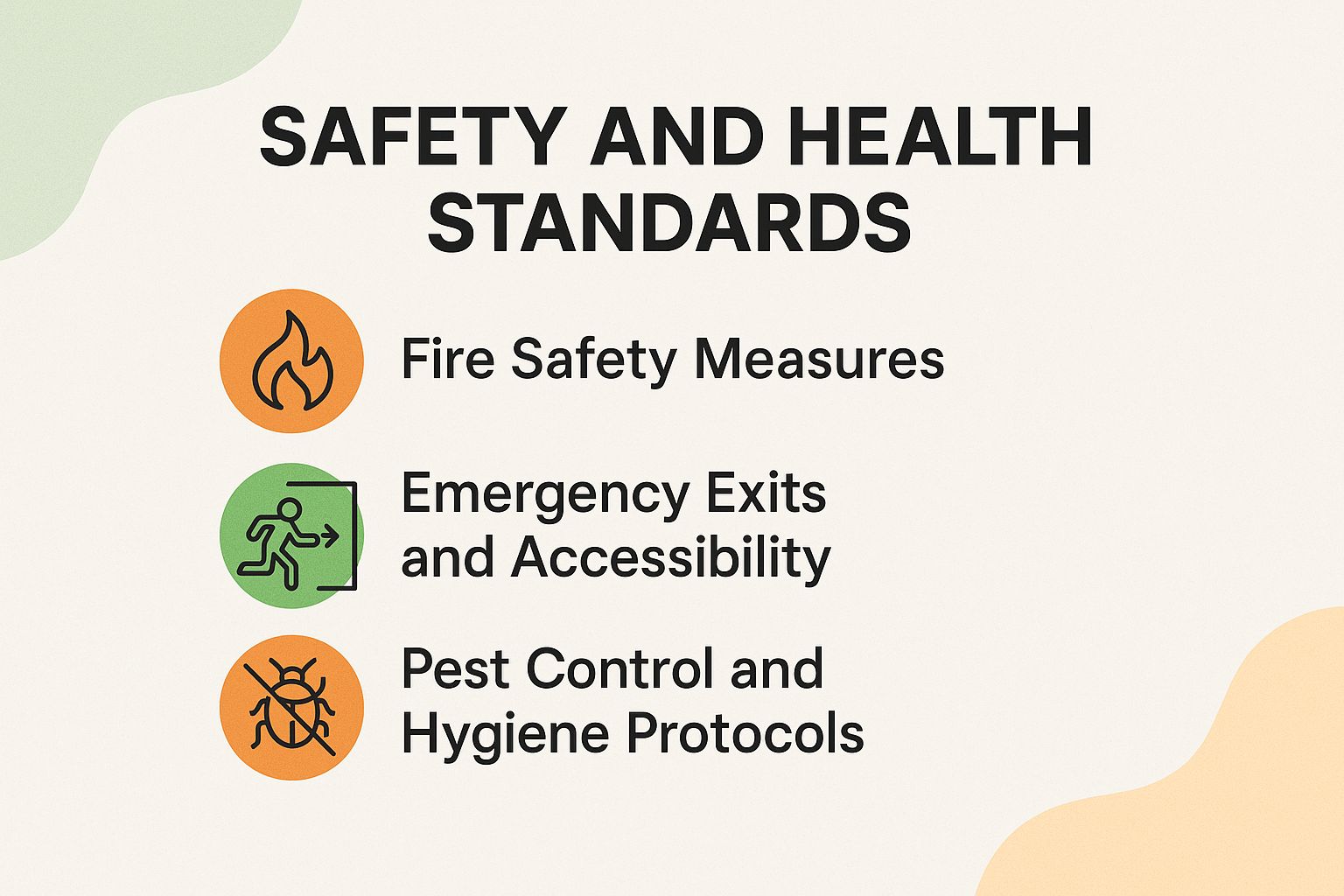
Adhering to OSHA 1926 standards in conversions prevents 15% of workplace incidents, as evidenced by a 2023 NIOSH study on modular worker housing.
Fire Safety Measures
Install smoke detectors (Kidde battery models, $15 each) and 2A:10B extinguishers every 50 ft, complying with NFPA 1 for trailers under 400 sq ft.
To improve fire safety in oilfield housing, use these five best practices:
- Interconnected Alarms Connect smoke and CO detectors (such as First Alert models for $20) between units. Test them every month according to NFPA 72 so they all alert together.
- Flame-Retardant Materials: Use Class A rated fabrics and bedding (UL 94 compliant, $50/kit from suppliers like Bulwark) for bunks and curtains.
- Sprinklers for Larger Spaces: Install automatic systems (Quick Response heads, $1,000 average per 500 sq ft unit) if trailers exceed 500 sq ft, as mandated by NFPA 13.
- Evacuation Drills Hold weekly sessions based on OSHA 1910.38, practicing situations that require a 2-minute exit.
- Maintenance Schedules: Inspect extinguishers quarterly using ABC dry chemical types.
A 2022 case study from a Texas Permian Basin oil camp (reported by the International Association of Drilling Contractors) highlights success: Early interconnected detectors averted a kitchen fire, preventing $100,000 in potential damages and injuries.
Emergency Exits and Accessibility
Each unit requires two exits that are 36 inches wide and equipped with panic hardware (Von Duprin bars at $300). This setup lets 6 people leave in less than 2 minutes, as stated in IBC 1006.
To implement this effectively, map out exit paths, furniture arrangement, and space planning using floor plan software like AutoCAD or free tools such as Floorplanner, ensuring 44-inch clear widths per ADA guidelines for ergonomics in multi-purpose rooms.
Install ADA-compliant ramps ($500 each) and grab handles for accessibility. Add glow-in-the-dark signage ($20 per unit) at all exits for visibility during emergencies.
Address common issues like blocked paths by enforcing storage rules in leases.
A DOL study from OSHA case logs shows such modifications reduced workplace injury claims by 40% in multi-unit buildings, enhancing overall safety compliance.
Pest Control and Hygiene Protocols
Implement monthly treatments with Orkin services ($100/visit) and HEPA vacuums (Dyson at $400) to maintain hygiene, preventing infestations that affect 25% of temporary sites and pop-up housing per CDC data.
To create a complete hygiene plan for temporary camps, follow these guidelines:
- Prevention: Seal entry gaps with expanding foam kits ($50 from Home Depot) around doors, windows, and foundations to block pests.
- Cleaning Schedule: Perform daily wipes using Lysol disinfectant wipes ($5/pack) on surfaces, followed by weekly deep cleans with steam mops.
- Monitoring Place Victor snap traps ($20 per pack) in high-risk areas, and check them every two weeks.
- Vendor Contracts: Secure annual plans like Terminix ($300/year) for proactive inspections and cleaning services.
The WHO emphasizes sanitation in camps to reduce disease transmission, recommending handwashing stations and waste segregation. Case studies, such as a South African mining site implementing similar protocols, cut illness rates by 50%, per a 2022 study in the Journal of Occupational Health.
Cost Analysis and Budgeting
Considering budget constraints, budgeting for conversion averages $15,000-$30,000 per unit including maintenance costs, with ROI in 6-12 months via reduced hotel and real estate costs ($5,000/month savings for 10 workers), while ensuring proper insurance coverage.
Conversion and Setup Expenses
Initial costs include $8,000 for structural mods (e.g., insulation and plumbing via local contractor services) plus $2,000 transport with flatbed trucks from U-Haul, ideal for commercial property.
Further expenses for an 8×40 shipping container conversion total $10,000-$20,000, per HomeAdvisor data on tiny home builds. A detailed breakdown follows:
| Category | Cost | Details |
|---|---|---|
| Insulation | $3,000 | Spray foam for 400 sq ft via Owens Corning kits |
| Plumbing | $4,000 | Fixtures and lines from PEX tubing suppliers |
| Electrical | $2,500 | Wiring and panels from Home Depot |
| Foundation | $1,500 | Concrete piers for stability |
For rentals, consider Williams Scotsman at $1,500/mo. Cut costs 15% through bulk buys from suppliers like Habitat for Humanity ReStores, focusing on DIY conversion where possible to save on labor.
Ongoing Operational Costs
Monthly operations run $500-1,000, covering utilities ($300 for power/water) and maintenance ($200 for HVAC systems and filters from Honeywell).
To manage these effectively, categorize costs with actionable metrics:
- Utilities: Track usage with a Kill A Watt meter ($20), assuming $0.15/kWh average; audit monthly to cut waste by 20%.
- Maintenance: Schedule annual roof inspections ($500) to extend lifespan by 5 years; replace filters quarterly for efficiency.
- Cleaning: Budget $100/month for supplies like eco-friendly cleaners; hire local services for deep cleans bi-annually.
This approach saves 40% over hotel operations, per SHRM data. Use QuickBooks ($25/month) for tracking and forecasting expenses.
Potential ROI and Funding Options
Achieve 25% ROI in year one by housing 20 workers, cutting relocation costs from $10,000 to $2,000 each, as in a Bechtel project yielding $150,000 savings.
To calculate this ROI, use the formula: (Savings – Costs) / Costs x 100. For instance, with $160,000 total savings ($8,000 per worker) minus $100,000 setup costs, you get ($160,000 – $100,000) / $100,000 x 100 = 60% ROI-surpassing the 25% target.
Funding options include:
- SBA loans (up to $5M at 7% interest for infrastructure);
- Leases like Pac Van modular units ($2,000/month for 20 beds);
- HUD workforce grants (average $100K).
An oil firm in Texas recouped costs in 8 months via on-site housing, boosting productivity by 15% per OSHA studies.
About the Author
I’m Ethan Caldwell, a University of Colorado graduate with a degree in Environmental Engineering and the owner of a modular office company based in Oregon. For over 11 years, I’ve helped businesses across the Pacific Northwest and beyond implement smart, sustainable, and high-performance storage and workspace solutions. As an editor for Mobile Office Deals, I specialize in helping people make the right call when it comes to modular infrastructure.